
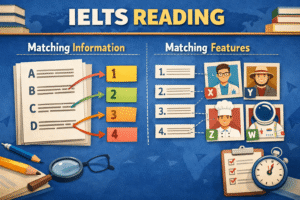
1. প্রশ্নের ধরন সংক্ষিপ্ত বিবরণ
1.1 Matching Information
- Definition: আপনাকে passage-এর section-এ থাকা specific details খুঁজে বের করতে হবে।
- Matching Headings থেকে পার্থক্য:
- Matching Headings → paragraph-এর main idea চিহ্নিত করতে হবে।
- Matching Information → specific facts or details খুঁজতে হবে।
- Typical Task: কোন section-এ দেওয়া তথ্য আছে তা খুঁজে বের করা।
1.2 Matching Features
- Definition: একটি set of statements/questions কে options-এর সাথে match করতে হবে (সাধারণত researcher, findings বা profession)।
- Key Features:
- Questions numerical order-এ না থাকতে পারে।
- Options passage-এ সাধারণত order-এ থাকে।
- একই option আবারও আসতে পারে।
- General Training উদাহরণ: বিভিন্ন profession বা sport match করা।
- Academic IELTS উদাহরণ: researcher-এর findings match করা।
2. Matching Information Question-এর Strategy
- Passage Title পড়ুন:
- বিষয়টা বুঝতে সাহায্য করে।
- Option reuse বুঝুন:
- Letters (A, B, C…) একাধিকবার ব্যবহার করা যায়।
- সাধারণত একটি section-এ দুইটি উত্তর থাকতে পারে।
- Questions বিশ্লেষণ করুন:
- Keywords highlight করুন।
- প্রতিটি question-এর topic মনে রাখার চেষ্টা করুন।
- Passage section-by-section পড়ুন:
- দেখুন section-এ question-এর তথ্য আছে কি না।
- উত্তর মিলে গেলে mark করুন।
- কিছু না মিলে গেলে next section এ যান।
- Missing Answers:
- যদি কোনো উত্তর না পান, বাকিগুলো শেষ করার পরে ফের চেষ্টা করুন।
- Practical Tips:
- দীর্ঘ section হলে প্রথম অর্ধেক পড়ুন, পরে দ্বিতীয় অর্ধেক।
- Paraphrased words খুঁজুন, exact match নয়।
Example Practice: Tomatoes Passage
- Question 17: Comparison between early domestication and recent research → Section A
- Question 15: Problem when focusing on certain types of tomatoes → Section B
- Question 18: Personal reaction to flavor → Section C
- Question 14: Type of tomato resistant to disease → Section D
3. Matching Features Question-এর Strategy
- Questions-এর Keywords Highlight করুন
- Option (e.g., researcher name, profession) খুঁজে বের করতে সহজ হবে।
- Passage-এ Option Scan করুন:
- নাম বা key identifiers খুঁজুন।
- Option mention হলে slow down করে পড়ুন।
- Questions-এর সাথে Match করুন:
- পড়া তথ্য question statement-এর সাথে মিলে কিনা দেখুন।
- Order Tips:
- Numerical order অনুযায়ী উত্তর দিবেন না।
- Passage-এ option সাধারণত order-এ থাকে।
Example Practice Table: Tomatoes Passage
| Question | Statement | Answer | Section/Clue |
| 23 | Humans only use a small proportion of plant food | A | 50,000 edible plants, mostly 15 crops |
| 22 | Efforts to domesticate one wild fruit | B | Vanek & Golden Berry, costly process |
| 20 | Idea of unusual plants may not be widely accepted | D | Jones – new foods may not become staple crops |
| 19 | Plants adapting to future environmental changes | C | GAO – crops thriving as the planet warms |
| 21 | Not advisable to disclose future research | A | Kudha – secretive about species selection |
4. গুরুত্বপূর্ণ টিপস
- Keywords Highlight করুন:
- Proper nouns, technical terms, unusual words খুঁজুন।
- Section Title ব্যবহার করুন:
- Section-এ কি আছে তা বোঝার hint দেয়।
- Section-এ যদি কোনো উত্তর না থাকে:
- Panic করবেন না। এটা স্বাভাবিক।
- Paraphrasing Awareness:
- উত্তরগুলো সাধারণত word-for-word নয়। Synonyms খুঁজুন।
- Time Management:
- দ্রুত না খুঁজে পারলে skip করুন।
- পরে ফিরে গিয়ে চেষ্টা করুন।
5. Practice Recommendation
- Cambridge Practice Tests ব্যবহার করুন (Test 17, Test 2)।
- Correct answer count করুন।
- Matching Headings vs. Information vs. Features পার্থক্য বুঝুন।
6. Summary Table
| Question Type | Goal | Approach |
| Matching Information | Locate specific details in sections | Read title, highlight keywords, check each section, mark answers |
| Matching Features | Match statements/questions to listed options | Highlight keywords, scan for options, carefully read associated info |
Remember:
- Matching Information → detail-focused
- Matching Features → option-focused, order matters
Homework / Practice Activity
- Cambridge Practice Test 17, Test 2:
- Matching Information (Questions 14–18)
- Matching Features (Questions 19–23)
- Questions এবং passage-এ keywords এবং paraphrases highlight করুন।
- Answer লিখে self-check করুন।
Sample Passage (Excerpt)
Title: The History of Chocolate
Chocolate has a long history, dating back over 3,000 years. The Mayans and Aztecs originally consumed it as a bitter drink, often mixed with spices. When it reached Europe in the 16th century, sugar was added to make it sweeter, and it quickly became a popular treat among the wealthy.
By the 19th century, technological innovations allowed chocolate to be mass-produced, making it available to the general public. Modern research has shown that dark chocolate contains antioxidants that may improve heart health. However, excessive consumption can lead to health problems such as obesity and dental issues.
Recently, sustainable farming practices have been introduced to protect cocoa-growing regions and support fair wages for farmers. Companies are also experimenting with new flavors and types of chocolate, including sugar-free and vegan alternatives.
Sample Questions
Instructions: Match the following pieces of information to the correct paragraph (A–D).
- Paragraph A: Mayans and Aztecs, bitter chocolate drink
- Paragraph B: Chocolate in Europe, sweetened and popular
- Paragraph C: Modern research on health benefits
- Paragraph D: Recent innovations and sustainable farming
Questions:
- The introduction of chocolate to Europe and its popularity among the wealthy.
- Health effects of chocolate consumption, both positive and negative.
- Early use of chocolate by ancient civilizations.
- Efforts to make chocolate production more sustainable and new product developments.
Another Short Practice Passage
Title: Electric Cars and the Future of Transportation
Electric cars have existed since the late 19th century but were overshadowed by gasoline vehicles due to cost and performance limitations. In recent decades, battery technology has improved, allowing longer travel distances and faster charging. Governments around the world are promoting electric vehicles to reduce carbon emissions.
Automakers are also investing in research to make electric cars more affordable and widely available. Some companies are exploring self-driving technology in electric vehicles, which could transform transportation in the coming decades.
Questions: Match the information to paragraphs.
- Early history and challenges of electric cars.
- Government initiatives to reduce pollution.
- Innovations in battery and self-driving technology.
- Efforts to make electric cars more affordable.
Paragraph Options:
- A → History and early challenges
- B → Government initiatives
- C → Technological innovations
- D → Affordability improvements